2023 Distinguished Service Award
Dr. Xiaobing Li
Dr. Li has served our organization for a long time and has indeed made great contributions to the CHUS. In addition to serving as the former CHUS President and chairing numerous committees, Professor Xiaobing Li has diligently served as the sole editor of The Chinese Historical Review (CHR) for over four years. Demonstrating exceptional dedication to this esteemed scholarly, peer-reviewed journal, he independently manages the entire process—from receiving papers and finding peer-reviewers to contacting authors and liaising with the publisher. His outstanding commitment is particularly noteworthy, considering the typically substantial responsibilities associated with running a journal, which are often handled by a company or a group of scholars.
2022 Distinguished Service Award
Dr. Pingchao Zhu has served our organization for a long time, and indeed has made her great contributions to the CHUS. Besides having served on many committees for the CHUS in the past years, Professor Zhu has served and chaired the Committee for Academic Excellence under at least four CHUS presidents (under Drs. Xiaobing Li, Qiang Fang, Zhiguo Yang, and now Yi Sun). In this committee, Professor Zhu and her hard working colleagues spent a lot of time reading, reviewing, and recommending promising scholarships of our CHUS members. She was also a CHUS Board member between 2005 and 2007. She often participated in the CHUS organized activities and contributed to the organization in various ways. Overall, she is a distinguished member and a long-term servant of the CHUS.
2020 Distinguished Service Award
Dr. Xiaojia Hou, Associate Professor of History, San Jose State University
Dr. Dandan Chen, Associate Professor of History, Farmingdale State College
2016 Distinguished Service Award
The Committee of the Distinguished Service Award (Drs. Haochao Lu, Zhiguo Yang, and Patrick Fuliang Shan) recommended the CHUS to bestow this year’s award upon Dr. Xi Wang because of his indispensable and long-term dedicated contributions to the organization. A summary of Dr. Xi Wang’s excellent services to the CHUS is as follow:
Dr. Xi Wang was one of the founding members of the Chinese Historians in the United States (CHUS), and ever since he has been an active member. He has provided his excellent services in the following areas: offering contributions to CHUS’s founding and its early growth, reviving the publication of The Chinese Historical Review (CHR), and promoting the CHUS in the global community, in particular in mainland China.
(1) Dr. Wang’s contributions to the establishment and growth of the CHUS (1987-2002).
Dr. Wang was a member of the founding group that was responsible for establishing the CHUS at Columbia University in New York City in the summer of 1987. Led by Dr. Wangling Gao, then professor of Chinese history from Renmin University and a Luce Fellow at Columbia University, the members of the group included Drs. Yan Li (University of Connecticut), Xiaofeng Tang (Syracuse University), Zheng Gao (James Z. Gao, Yale University), Yong Chen (Cornell University), and Hong Cheng (University of California at Los Angeles). Dr. Wang was responsible for designing the program, preparing documents, and making local arrangements for the founding meeting, which was attended by about seventy Chinese and American scholars and graduate students of history.
Dr. Wang served as the president of the CHUS from 1988 to 1989 and led CHUS’s second board of directors, which included Drs. Xin Zhang (University of Chicago, Vice President), Chengyang Li (University of Connecticut, Treasurer), Qiang Zhai (Ohio University, Newsletter Editor), and Hong Chen (UCLA, Organization Coordinator). During this term, the board of directors made the decision to transform Historians, the original CHUS newsletter, into a scholarly publication and register it with the Library of Congress as Chinese Historians (ISSN 1043-643X). The board also decided to create a new newsletter (Hui yuan tong xun) for CHUS’s internal communication and exchanges. Both are still in publication, with the Chinese Historians being replaced by the CHR, and the newsletter being published electronically. In 1989, by working with the Henry Luce Foundation, Dr. Wang successfully obtained a grant from the foundation that helped fund CHUS’s second annual meeting, held at UCLA in the summer of 1989, and the publication of Chinese Historians for the next three years.
In 1991, Dr. Wang assisted Dr. Z. George Hong (Zhaohui Hong), president of the CHUS (1990-1991), in working with the Henry Luce Foundation to secure a major grant for CHUS’s “China Teaching Project,” which sent ten CHUS members to Chinese universities in Shanghai, Beijing, Hangzhou, and other cities to teach history and conduct academic exchanges in the summer of 1991. Dr. Wang wrote grant proposals and summary report for the projects, and held working meetings with the foundation. The success of the project ultimately led to Luce Foundation’s decision to renew its support for the project. The grants from this project had enabled successive CHUS boards of directors to fund the publication of Chinese Historians.
In April 1998, Dr. Wang worked with Dr. Hongshan Li, president of the CHUS (1997-1999) and Dr. Xiaobing Li, then president of the American-Chinese Professors of Social Sciences (ACPSS), to organize a joint workshop on “Teaching Humanities and Social Sciences with Computing Technology” at Indiana University of Pennsylvania (IUP), where he secured a President’s Special Project grant and other resources of institutional support. Dr. Wang designed the program and made all of the local arrangements for the two-day workshop, which featured with more than thirty original presentations and was attended by more than sixty scholars coming across the United States and even included a few scholars from universities in China.
From 2001 to 2002, Dr. Wang served as the editor of CHUS Newsletter. In 2005, he made a vital contribution to the bylaws of the CHUS by suggesting an insertion of a provision that would place the ownership of CHR in the hands of the CHUS board of directors and members.
(2) Dr. Wang’s leadership role in reviving the publication of The Chinese Historical Review (CHR) (2003-2014).
In spring 2003, Dr. Wang was invited by Dr. Di Wang, president of the CHUS (2003-2005), to take up the task of reviving the publication of Chinese Historians, which by then had stopped its regular publications for nearly three years. Joined by Drs. Hanchao Lu (Georgia Tech) and Alan Baumler (IUP), Dr. Wang led a sweeping endeavor to renew the publication of the journal. Within the first year, the new editorial group established a new set of editorial and operational guidelines, solicited quality research papers, created a database of peer reviewers, and conducted an extensive campaign for publicity and reconnections with CHUS members, institutional subscribers, members of editorial board, university presses and other professional journals. In the meantime, Dr. Wang worked to secure institutional support, in both financial and administrative terms, from IUP (his home institution). In hindsight, the most important decision he has made, with the support of the editorial group, was to re-register the journal with the Library of Congress under the new title The Chinese Historical Review (ISSN 1547-402X). He defined the scope and nature of the journal as “a biannual academic journal of historical studies devoted to publishing original and solid research concerning the history of China, China’s historical relations with the world, history of the overseas Chinese, and comparative studies of history in general.” The first issue of CHR was published in spring 2004. The journal’s regular publication has not been delayed or interrupted ever since then.
Under his chief editorship from 2004 to 2014, CHR published 22 issues (twice every year), which altogether carried, among other things, 79 original research articles, 57 forum and research note articles, and 84 book reviews, authored by scholars from North America, Asia, Europe, Australia, and New Zealand. The subscription of the journal began with zero in 2004 but increased to over 250 by 2011, with some of the major academic libraries around the world being among the subscribers.
While Drs. Hanchao Lu and Alan Baumler played an important role in soliciting, in-house screening, evaluating, and editing submissions, Dr. Wang took charge of overseeing the journal’s operation and production. His routines as the chief editor included: maintaining the database of submissions, in-house screening manuscripts, making editorial decisions with editors, editing and sometimes translating manuscripts, proofreading, issue and cover designing, writing editorial introductions for most of the published issues, indexing, securing funds (from 2004 to 2011) for printing, maintaining effective communication with authors and peer reviewers, record-keeping for subscriptions, negotiating with printers, submitting annual report to the board of directors (except for the year of 2014), overseeing the process of printing and mailing (Dr. Ping Yao, who served as president of the CHUS from 2007 to 2009, assisted the work of printing and mailing from 2009 to 2011). Much of Dr. Wang’s work was done over the weekends and in many extra hours he could find after finishing his twelve hours’ teaching load per week (or six hours when he was the department chair from 2005 to 2008, or when he did transnational teaching between Peking University and IUP) from 2003 to 2014.
By 2011, with its rising reputation as a rigorously edited academic journal of Chinese history, CHR was approached by the UK-based Maney Publishing for entering a publication partnership.
With the support and approval of the CHUS, Dr. Wang represented CHR to negotiate a contract of partnership with Maney, by which the CHUS would retain its ownership of the journal, CHR would retain its original and complete powers over the journal’s content and intellectual quality, and Maney would be responsible for printing, marketing, and distributing the journal worldwide in electronical and print formats. The partnership went into effect in 2012 and has been operated successfully. Upon the entry of the partnership with Maney Publishing (now owned by Francis & Taylor, Inc.), Dr. Wang started his efforts to reorganize the editorial board, which now includes a wide representation of scholars in different regions and fields.
In December 2014, Dr. Wang transferred his responsibility as chief editor, together with the journal’s electronic archives and two issues projected for publication, to Professor Hanchao Lu, the new chief editor, thus completing his own task that had started twelve years before.
(3) Dr. Wang’s services for promoting the cause of the CHUS and CHR (2010-2015)
Dr. Wang’s two Chinese publications may be perceived as a special kind of service for promoting the cause of the CHUS and CHR. The first, Discovering History in America: Reflections of Chinese Historians in the United States (co-edited with Dr. Ping Yao, Beijing: Peking University Press, 2010), includes thirty-one deeply thought-provoking essays written by CHUS members, who shared their individual and collective experience of studying and teaching history in American colleges and universities. The book was well received not only as an honest revelation of the inner world of the first-generation of humanities students from the People’s Republic of China, but also as a valuable primary source for studying the history of overseas Chinese historians and one of their organizations: the CHUS.
The second book, Pathmakers: Conversations with Renowned Historians (co-edited with Drs. Hanchao Lu and Ping Yao, Beijing: Peking University Press, 2015), is a Chinese version of fourteen interviews with world-renowned historians, most of which were conducted by CHR editors and CHUS members and were originally published by CHR. The award-winning book has contributed to the Chinese learning of history, and offered its precious values from CHUS members to the historians in China.
(4). A short biographical sketch of Dr. Xi Wang
Dr. Wang received his Ph.D. in American history from Columbia University in 1993. He was a Du Bois Postdoctoral Fellow at Harvard University (1993-94). He is a professor of history at Indiana University of Pennsylvania where he has been teaching 19*h century United States history since 1994. He holds a Changjiang Scholar position in the History Department of Peking University, where he teaches courses on the American Civil War and the Reconstruction, U.S. Constitutional History, and African-American History. He has authored and edited six books, including The Trial of Democracy: Black Suffrage and Northern Republicans, 1860-1910 (Athens: University of Georgia Press, 1997, 2012 paperback), Principles and Compromises: The Spirit and Practice of the American Constitution, Expanded Edition (Beijing: Peking University Press, 2014, original edited in 2000 and revised edition in 2005), and Trans-Pacific Conversations: Doing History in a Global Age (Beijing: The Commercial Press, 2017, forthcoming). His translations include: Eric Foner, The Story of American Freedom (Beijing: The Commercial Press, 2002) and Eric Foner, Give Me Liberty! An American History, Two Volumes (Beijing: The Commercial Press, 2010). He is a member of the International Committee of Organization of American Historians.
2017 Distinguished Service Award
Professor Danke Li, a faculty teaching Chinese history at Fairfield University in Connecticut, has been a member of the CHUS Board for three terms. During her tenure as the board member, she has worked diligently as the conference organizer. In this role, she has worked effectively with the American Historical Association (AHA) conference coordinators to retrieve relevant information. She has always sent out calls for panels and papers to CHUS members in a timely manner. She has collected information of panels, including abstracts, and inserted all relevant information manually into the AHA system. This is a tedious job, as it might take a week or so to insert all information by hand. Any minor errors might cause issues, which might lead to rejection by the AHA. In the past years, all CHUS panels under her management were accepted without any issues, which guaranteed the smooth and successful operations of the CHUS as a national scholarly organization. She has also served as a panel chair or a discussant. In addition, she has always offered her valuable services to the CHUS and its members whenever she is
needed.
Professor Xiaoping Cong, a faculty teaching Chinese history at the University of Houston, Texas, served as the CHUS president between 2011 and 2013. During her tenure as the leader of this organization, Dr. Cong worked diligently. She conducted reforms and created new venues for the routine operations of the CHUS. Furthermore, she updated the CHUS website by building a new server, and endeavored to reach out for public support for the CHUS. More importantly, she launched a fund-raising campaign, and amazingly obtained a few donations, amounting to more than four thousand dollars from outside donors, which enormously improved the CHUS’ financial situation. During her presidency, Dr. Cong did her best to support the CHUS journal, The Chinese Historical Review, and her efforts guaranteed the timely publication of the journal. She has also served as the chair or a member of various CHUS committees, and has been an active participant of other CHUS activities.
2015 Distinguished Service Award
Dr. LU Hanchao was the 2015 Distinguished Service Award recipient. Dr. Lu has made great contributions to the journal as the editor in the past years.
2012 Distinguished Service Award
This year’s Distinguished Service Award goes to Professor Zhang Jiayan. Professor Zhang Jiayan served as the CHUS secretary from 2009 to 2011. During his term he devoted a lot of his time and energy to establish a positive image of CHUS, to recruit new members, and to handle routine issues of the organization. His contributions were indispensable to the routine operations of the CHUS. Patrick Shan, former president of CHUS and nominator of Professor Zhang, praises that “Professor Zhang has set an example for his excellent service in our CHUS community. He truly deserves the Award for Distinguished Service, for which he has my highest recommendation.”
2011 Distinguished Service Award
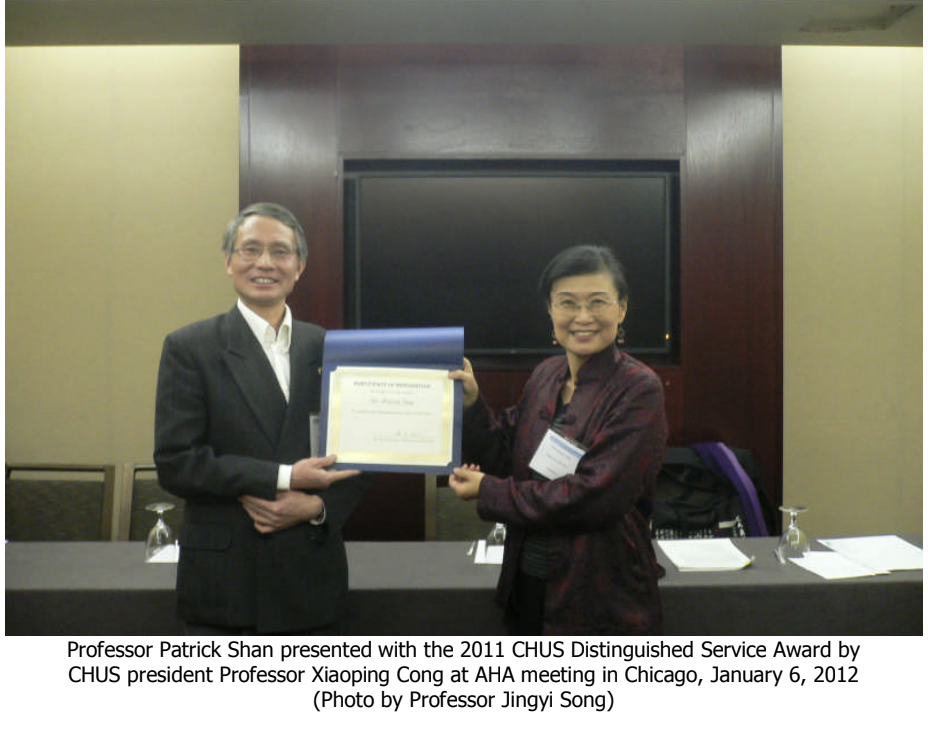
Professor Patrick Fuliang Shan of Grand Valley State University was the recipient of the 2011 CHUS Distinguished Service Award, announced at the CHUS business meeting at the AHA on January 6, 2012. During the past several years, in addition to fulfilling his various responsibilities as CHUS president, Professor Shan took care of the filing of federal tax returns for CHUS, successfully reestablished CHUS’s tax exemption status, and re-registered CHUS with the state of Michigan, thereby enabling CHUS to maintain its legal status. To save legal fees for CHUS, Professor Shan spent countless hours researching relevant legal documents and preparing, submitting, and resubmitting application materials—tasks that are usually performed by lawyers.
2010 Distinguished Service Award
Professor Xiaobing Li was the winner for his long-term and significant contributions to our organization.
2009 Distinguished Service Award
Professor Ping Yao (California State University, Los Angeles) was recipient of the Award for Distinguished Service for the many fine years she has committed to the CHUS.
2007 Distinguished Service Award
The 2007 Award for Distinguished Service to CHUS was granted to professor TIAN Xiansheng.