AI in Teaching

Speakers: Dr. Eileen Cheng-yin Chow, Dr. Qian He, Yiming Ma

Moderator: Dr. Yi Ren

When: January 15, 2026, 20:00-22:00 EST (January 16, 9:00-11:00 AM Beijing Time)

Where: Zoom. Please register in advance for this event at

https://ualr-edu.zoom.us/meeting/register/l5YQsem4QOah-gbMWHwbcA

Dear Colleague,

How can we meaningfully integrate AI into our teaching, beyond the concerns about cheating or the excitement of new tools? In this online workshop, three scholars will share concrete ways they use AI to enrich university-level teaching. They will discuss approaches such as using LLMs to build interactive learning environments, supporting personalized learning through tailored feedback and accessibility tools, and designing assignments that remain rigorous and engaging without fully banning AI. Please join us to explore thoughtful and hands-on ways of incorporating AI into your teaching practice!

Sincerely,

Dr. Yi Ren

Speakers:

Dr. Eileen Cheng-yin Chow, Associate Professor of the Practice in Chinese and Japanese Cultural Studies and Director of Asian/Pacific Studies Institute at Duke University

Dr. Qian He, Lecturer at the University of International Relations

Yiming Ma, Ph.D. Candidate in the Department of East Asian Languages and Cultural Studies at University of California, Santa Barbara

AI in Humanities Research

Speakers: Dr. Bo An, Dr. Keyao Pan, Haiying Wei

Moderator: Dr. Yi Ren

When: December 4, 2025, 20:00-22:00 EST (December 5, 9:00-11:00 AM Beijing Time)

Where: Zoom.

Dear Colleagues,

What can humanities researchers do with AI, beyond the hype, fear, and fascination? In this online workshop, three early-career scholars working at the intersection of artificial intelligence and the humanities will share how they use AI tools in their own research. They will showcase tools such as LLM-based Q&A systems, visualization tools that reveal how LLMs process meaning, and terminal-based LLM tools that support and reimagine humanities research. Join us to explore practical ways of integrating AI into your own research toolkit. No prior experience with AI tools is needed, just curiosity and a willingness to explore!

Sincerely,

Dr. Yi Ren

Speakers:

Dr. Bo An, Research Assistant Professor of History at Lingnan University, will teach how to use LLMs to accomplish humanities research tasks and make basic research applications via terminal LLM clients and MCPs.

Dr. Keyao Pan, Assistant Professor of Digital History at Florida International University, will discuss the use of visualization tools like Nomic Atlas to understand how LLMs process meaning, and to support more effective teaching and collaboration.

Haiying Wei, Ph.D. Candidate in Political Science at Columbia University, will introduce an online Q&A system powered by LLMs, designed to support researchers in synthesizing literature, generating ideas, and exploring new research directions.

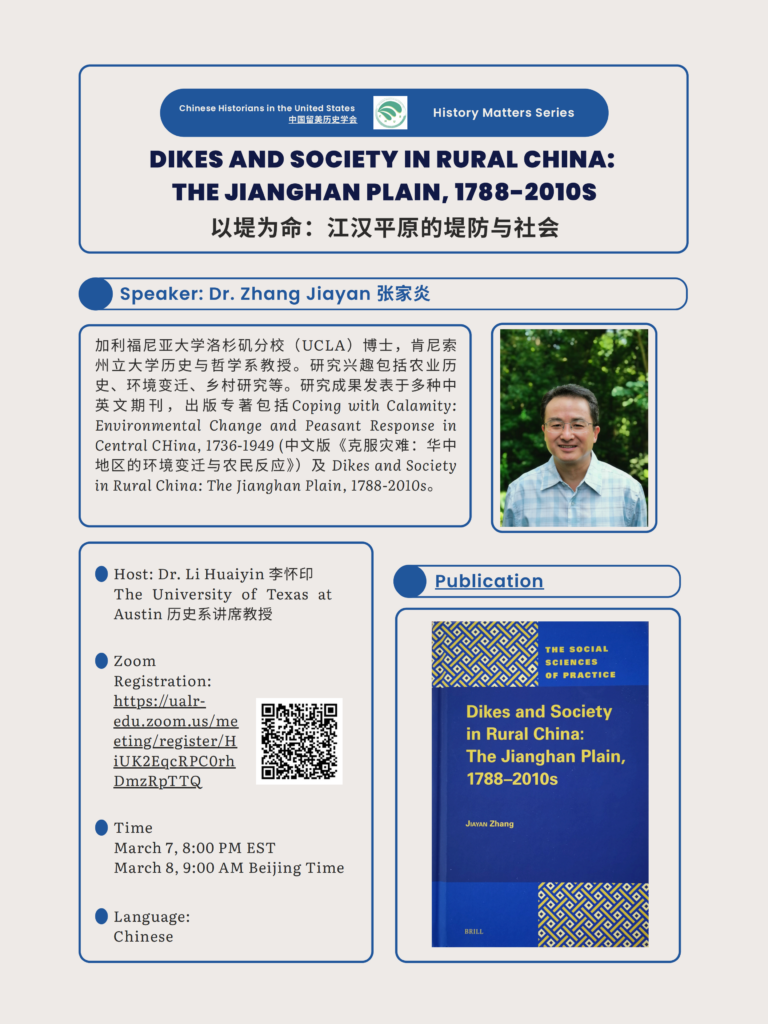
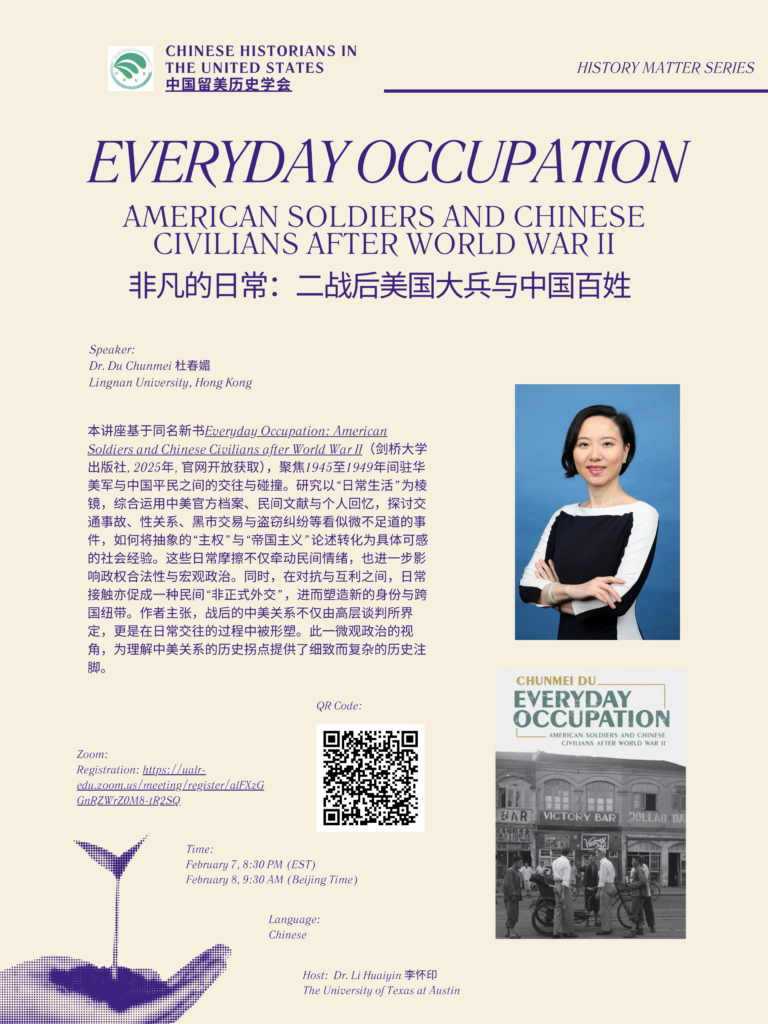
日常食物?超级食物?番薯的全球之旅 Staple to Superfood: A Global History of the Sweet Potato

主讲嘉宾王晴佳博士 ,美國羅文大學歷史系傑出教授 (Dr. Q. Edward Wang, inaugural Eminent Professor at the College of Humanities and Social Sciences at Rowan University)

演讲题目及简介: 《日常食物?超级食物?番薯的全球之旅》

本講座基於王教授即将问世的新著, Staple to Superfood: A Global History of the Sweet Potato (哥伦比亚大学出版社2025年12月),透過追溯蕃薯的全球旅程,闡明這一作物如何在不同社會中扮演相異角色,並以此改變社會,展現全球現代化歷程的多元圖景。

Political, Cultural, and Diplomatic Networks

Saturday, January 10, 2026: 3:30 PM-5:00 PM
Marshfield Room (Palmer House Hilton, Third Floor)
Session Organizer: Patrick Fuliang Shan, Grand Valley State University
Chair: Qiang Fang, University of Minnesota, Duluth
Papers:
Language, Commerce, and Empire: Introducing Chinese Instruction into US Higher Education, with Harvard as a Case Study
Shuhua Fan, The University of Scranton

“Securing and Holding Our Share of Influence and Trade in China”: Edwin Conger and US–China Relations at the Turn of the 20th Century
Tao Wang, Iowa State University

The Chinese Communist Party’s Transition from a Revolutionary Party to a Ruling Party, 1990s−2010
Xiaoqing Diana Lin, Indiana University Northwest

Who Are They? A Study of Chinese Legislators Elected During the First Nationwide Election in 1912–13
Patrick Fuliang Shan, Grand Valley State University

Comment: Guolin Yi, Providence College

Session Abstract: Political, Cultural, and Diplomatic Networks in China and Beyond”

This panel features four papers that explore the multifaceted relationships shaping the transformation of modern China and its interactions with the wider world. Since the mid-nineteenth century, China’s deep engagement with the international community has fostered exchanges of ideas, experiences, and models of development. Through these interactions, the Chinese sought new approaches to nation-building and state formation. The papers examine the evolving political, cultural, and diplomatic networks both among the Chinese themselves and between the Chinese and foreign actors. Together, the panelists offer fresh insights into how these transnational networks emerged through the adoption of new ideas, the forging of new relationships, and the pursuit of new goals. Collectively, these studies reveal how modern China’s history was shaped by a web of interconnected ideas, experiences, interpretations, and decisions born from its dynamic engagement with the world—an engagement that ultimately influenced the course of China’s national development.

Paper Abstracts

Language, Commerce, and Empire: Introducing Chinese Instruction into US Higher Education, with Harvard as a Case Study

Shuhua Fan, The University of Scranton

Serious efforts to introduce Chinese instruction into American colleges started in the 1870s with the inauguration of Chinese classes at Yale and Harvard and the establishment of an endowed professorship at the University of California-Berkeley. This paper uses the first Harvard Chinese language class (1879-1882) as a case study to examine the rise of pioneering Chinese programs in America in the late 19th century. Harvard started its Chinese class in 1879 because of the Chinese Educational Scheme presented in 1877 by Francis Knight, a U.S. consul and merchant. Authorized by Harvard, Knight made thorough preparations on both sides of the Pacific Ocean, including recruiting teacher Ko Kunhua, a Chinese poet, to carry out his scheme. The Chinese class came to a sudden end in 1882 due to Ko’s death, with no more help from Knight who died in 1880.

Using both primary and secondary sources, this paper explores the ways how domestic developments in the U.S. and China, U.S.-China interactions, and broader international context shaped Knight’s educational scheme. It argues that Knight’s scheme and the Harvard Chinese class reveal the interconnections among empire, commerce, Christianity, language, and higher education in late 19th century U.S.-China relations. These similar factors can help explain the rise of other Chinese programs in the U.S. and the rise of new or expansion of existing Chinese programs in Europe in the age of new imperialism. The paper also shows that the end of the entire program at Harvard with the teacher’s passing indicates that the cultural network constructed by Knight and participated by Ko was fragile, depending totally on one or two particular individuals’ availability or efforts. This paper fills a gap in the study of the pioneering Chinese language programs in American academia and contributes to the expanding literature on 19th century U.S.-China relations.

“Securing and Holding Our Share of Influence and Trade in China”: Edwin Conger and US–China Relations at the Turn of the 20th Century

Tao Wang, Iowa State University

As U.S. minister to China from 1898 to 1905, Edwin Conger underwent one of the most tumultuous periods in U.S.-China relations, including the European powers’ “Scramble for China” after the first Sino-Japanese War, the Hundred Days Reform, the anti-Christian riots culminating in the Boxer Rebellion, the U.S. espousal of the Open Door Policy, and the Chinese boycott of American products in 1905, which was the first nationalist movement in modern Chinese history. As the top U.S. diplomat in China, Conger played a crucial role in U.S. China policymaking during this period; yet the existing works have not examined his influence.

Using the diplomatic documents from the Department of State and the personal files such as those from Edwin Conger’s wife Sarah Conger, this paper explores the U.S. policy toward China during this period. It will answer the following questions: How did the U.S. respond to European imperialism in China? What was the U.S. perception of China’s modernization efforts and its internal power struggle? What factors contributed to the Open Door Policy, which served as the foundation of U.S. policy towards China for the first half of the 20th century? How did the U.S. meet the challenges of Chinese nationalism? And what role did Conger play in the U.S. China policymaking? This paper argues that the United States had successfully secured its interests to some extent while helping the Chinese, although it had limited presence and influence in China. Edwin Conger employed his personal connections in China to persuade his American colleagues to assume a practical attitude towards China. Consequently, his persuasive analysis of the Chinese situation and his poignant proposals had contributed significantly to America’s pragmatic foreign policy.

The Chinese Communist Party’s Transition from a Revolutionary Party to a Ruling Party, 1990s−2010

Xiaoqing Diana Lin, Indiana University Northwest

Calls for the Chinese Communist Party (CCP) to transition from a revolutionary party to a ruling party began in the aftermath of the June 4, 1989, government crackdown on student movements, and the collapse of the USSR. These events, along with major political campaigns in Communist China up to the Cultural Revolution, were perceived as the results of revolutionary and populist movements and were widely viewed as destructive and disruptive. These developments deeply influenced conservative-leaning Chinese reformers, prompting a reevaluation of radical and revolutionary approaches to modernization.

A key representation of this gradual shift in the CCP’s approach was the changing profile of its intellectual leadership or “brainpower.” The party moved from relying on Marxist theoreticians like Hu Qiaomu to intellectuals with broader academic training, such as Wang Huning. Before joining the CCP leadership in 1995 at the age of forty, Wang was a professor of international politics at Fudan University. He advocated for an institutional developmental approach over open democracy to advance China’s economy. His perspective drew on the successful stories of China’s Asian neighbors, including Japan, South Korea, and Singapore. Today, rebuilding China’s bureaucratic infrastructure remains a top priority for the CCP, with Wang’s ideas enjoying broad endorsement within the party. This paper explores how the CCP has redefined its role, focusing on demarcating the boundaries of the state’s administrative realm. It examines the party’s bureaucratic development efforts and the growing advocacy for statism among government leaders and left-leaning public intellectuals.

Who Are They? A Study of Chinese Legislators Elected During the First Nationwide Election in 1912–13

Patrick Fuliang Shan, Grand Valley State University

The Chinese, after the 1911 Revolution, held the first and only nation-wide popular election in late 1912 and early 1913, during which the eligible voters, who made up ten percent of the total population, elected over eight hundred senators and congressmen (representatives). Those newly elected legislators traveled to Beijing to convene the first national congress on April 8, 1913, which could be seen as the first democracy in Chinese history. This congress did not last long, however, because it was disbanded by Yuan Shikai on January 10, 1914. Thus, the short existence of this congress has not attracted much scholarly attention.

When we study this congress, important questions should be asked in regard to those eight hundred legislators. Who were those senators and congressmen? What were their family backgrounds? Why could they be elected? What did they do before and during the election? What role did they play in the short-lived congress? Because this congress existed for only nine months, what did they do in the future? Did they collaborate with diverse political parties, such as the CCP and the KMT (or GMD)? All these questions are important scholarly issues concerning the identities of those historical actors of China’s state-building efforts after the collapse of the Qing Dynasty. The paper argues that those legislators were Chinese elites from diverse regions and that they had played an important role in shaping China’s republican politics. Because of the future complicated political landscape, they would embark on diverse political roads. Nevertheless, their personal experience mapped modern China’s historical trajectory, in particular during the long 20th century.

Global China

Saturday, January 10, 2026: 1:30 PM-3:00 PM
Marshfield Room (Palmer House Hilton, Third Floor)
Session Organizer: Shouyue Zhang, University of Melbourne
Chair: Guoqi Xu, University of Hong Kong
Papers:
Global Connections and Local Realities: Hong Kong Prostitution, 1904–35
Iris Boyun Lei, University of Hong Kong

Transpacific News Reporting: The Chongqing School of Journalism and the Negotiation of Press and Propaganda During Wartime, 1943–45
Di Luo, University of Alabama at Tuscaloosa

The Pan-Pacific Decades: China, Hawaii, and Interwar Pacific Internationalism, 1910s–30s
Bohan Zhang, Rice University

“God Called Me to the Land of My Forefathers”: A Chinese American Teacher in China During the First Half of the 20th Century
Shouyue Zhang, University of Melbourne

Comment: Charlotte Brooks, Graduate Center and Baruch College, City University of New York

Session Abstract:

This panel brings together scholars based from the U.S., Australia, and Hong Kong to explore the multidimensional interactions and exchanges that shaped the Pacific world in the twentieth century. We center on China’s pivotal role in negotiating global and local dynamics. By analyzing cultural, political, and intellectual exchanges across the Pacific, this panel illuminates how the Chinese diaspora engaged with global networks to navigate challenges of imperialism, internationalism, and modernity. The four papers span diverse yet interconnected themes, emphasizing the interplay between global forces and local realities while uncovering underexplored histories of cross-cultural influence and negotiation.

Rethinking the Global China and Chinese diaspora in the Pacific World, four presenters will share their rigorous research on this theme. Iris Lei reviews Hong Kong’s prostitution industry from 1904 to 1935, examining the intersection of gender and colonial modernity by considering its global integration. Dr. Di Luo focuses on the Chongqing School of Journalism during WII, revealing broader tensions between press freedom and wartime propaganda. Bohan Zhang explores Hawaii’s Pan-Pacific movement in China, shedding light on an underexplored cross of Chinese and Pacific history in the Interwar period. Shouyue Zhang studies Chinese Americans in China during the Chinese Exclusion Era, demonstrating that this reverse migration reshaped both their dual identities and the duality of Chinese modernization.

Together, these papers contribute to a broader discussion that redefines China’s global position and cultural identity during a century of transformation. This panel underscores the importance of global-local linkages, transnational mobility, and intellectual exchange in shaping the histories of Asia and America. The panel integrates interdisciplinary perspectives to illuminate how Chinese actors negotiated global crises, adapted international networks, and mediated cultural exchanges, thereby shaping national and transnational identities. By focusing on the circulation of knowledge, mobility, and institutional engagement, this panel repositions China as a central and active participant in the Pacific world, offering new insights into the complexities of global history. By engaging with themes of migration, education, journalism, and internationalism, this panel enriches our understanding of how China navigated and influenced the evolving global order in the twentieth century.

Paper Abstracts

Global Connections and Local Realities: Hong Kong’s Prostitution from 1904to 1935

Iris Boyun Lei, The University of Hong Kong

During Hong Kong’s early colonial period, a severe gender imbalance led to a rapid influx of prostitutes. By the early 20th century, the prostitution industry flourished. Shek Tong Tsui emerged as one of the most renowned red-light districts in the East, attracting prostitutes from Canton, Shanghai, Europe, and Japan. However, by the 1930s, growing feminist activism in Britain and the League of Nations’ global campaign against the “white slave trade” pressured Hong Kong to dismantle its legalized brothel system.

Existing scholarship predominantly examines prostitution through the lens of British colonial regulation, with much of the focus placed on the period before the 20th century. This study, however, shifts attention to the internal dynamics and external influences shaping Chinese prostitution between the 1900s and 1930s, drawing on extensive archival sources—including Po Leung Kuk records, tabloid newspapers, CO129 files, League of Nations reports, government documents, and memoirs.

Rooted in traditional brothel culture, Chinese society cultivated an internal space of romanticized, historically inspired brothels, with sensationalized tales and rigorous Established Customs. In contrast, the British colonial government incorporated Hong Kong’s prostitution industry into the broader regulatory framework of the British Empire, though it later came under increasing pressure from the global anti–white slavery movement. This interplay between internal expansion and external opposition created a paradoxical social landscape between 1900 and the 1930s—while the prostitution industry thrived domestically, international condemnation of the practice intensified. This tension ultimately culminated in 1935, when the Hong Kong government issued an official order to abolish the legalized prostitution system. By adopting a global, social, and spatial history approach, this research situates Hong Kong’s prostitution industry within broader transnational dynamics, offering new insights into the intersection of gender and colonial modernity.

Trans-Pacific News Reporting: The Chongqing School of Journalism and the Negotiation of Press and Propaganda during Wartime (1943-1945)

Di Luo, University of Alabama at Tuscaloosa

In 1943, two former classmates, Hollington Tong (1887–1971), China’s Vice- Minister of Publicity, and Carl A. Ackerman, Dean of the Pulitzer School of Journalism at Columbia University, collaborated to establish a wartime post- graduate school of journalism in Chongqing, China. Staffed by Columbia faculty and funded by the Chinese Nationalist government, this school aimed at training top-tier professional international news reporters for China. During its two years of operation, the school graduated two classes comprising fifty-seven students, many of whom went on playing vital roles in journalism, diplomacy, and education in post-war China and the United States.

While scholars have examined the Chinese Nationalist government’s efforts in international propaganda during the early years of World War II, the role of the wartime journalism school in Chongqing (1943–1945) remains largely understudied. This paper investigates the founding and operations of this school through archival materials, student-run newspapers, and private correspondence between Columbia faculty and their families. By analyzing the negotiation between professional journalism ideals, free press, and the state’s control of information during wartime, this study sheds light on the broader tensions between press freedom and propaganda. It highlights the critical role of trans-Pacific collaboration in shaping journalistic practices and underscores the ongoing relevance of understanding how access to and control over information are contested in moments of crisis.

The Pan-Pacific Decades: China, Hawaii, and the Interwar Pacific Internationalism, 1910s to 1930s

Bohan Zhang, Rice University

Recent scholarship on Pacific internationalism and Pan-Asianism in the twentieth century has predominantly focused on Japan and the Philippines, often overlooking China’s role. This research addresses that gap by examining the activities of Chinese migrants, diplomats, and athletes within the Pan-Pacific movement during the early twentieth century. It explores how these individuals strove for, questioned, or resisted unity across the Pacific Rim amid imperialism and political instability in China. A notable example is the 1931 Institute of Pacific Relations (IPR) Third Pan-Pacific Conference in Shanghai, marking the peak of Chinese public participation in trans-Pacific initiatives. Chinese scholars, characterized by their modern disciplinary expertise and national diplomacy efforts, were key participants in the Pan-Pacific organizations founded under the Wilsonian ideals in Hawai‘i. Additionally, this research focuses on the resistance to Wilsonian Pan- Pacific internationalism within China. Led by the Research Association for Oriental Issues in Beijing and supported by several regional Kuomintang branches, anti-IPR movements gathered Chinese journalists and party officials who opposed the Pan-Pacific agenda promoted by scholarly elites. Their opposition reveals the growing divide between nationalist perspectives and academic-driven internationalism. By focusing on Pan-Pacific organizations founded in Hawaii (Pan Pacific Union and Institute of Pacific Relations), this research sheds light on an underexplored aspect of Chinese and Pacific history in the Interwar period from the late 1910s to 1930s.

“God Called Me to the Land of My Forefathers”: A Chinese American Teacher in China During the First Half of the 20th Century

Shouyue Zhang, University of Melbourne

From 1912 to 1949, many educated American-born Chinese returned to their ancestors’ motherland. Their American educational background enabled them to serve in Chinese secondary and tertiary schools. They were motivated by several factors, like Chinese exclusion in North America and Christian missionary spirits. Joining the inquiries of Jennifer Bond, Charlotte Brooks, and Daniel H. Bays, I will re-examine the experiences and legacy of American teachers with Chinese ancestry in Republican China. Using family papers, oral sources, and university archives collected in the United States and China, I tentatively argue that Chinese American teachers contributed to the intellectual exchanges between America and China. Their worldviews differed from either returned Chinese international students or white American teachers in China. Transnational mobility reshaped returned Chinese Americans’ multiple national identities. Their home-returning routes inspired by the republican government’s propaganda shaped Chinese modernization narratives with a stigma of racial discrimination overseas. Racial discrimination and foreign invasion co-constructed the duality of Chinese modernization.